

Home/Blog/Shopify

Integrating Three.js with Shopify for 3D Product Customization

Integrating Three.js with Shopify for 3D Product Customization

Executive Summary

This case study explores the integration of Three.js, a powerful JavaScript library for 3D graphics, with Shopify to create immersive product customization experiences. Drawing from real-world implementations including Shopify's own BFCM 2025 interactive globe, furniture configurators, and jewelry customization tools, we examine the technical architecture, implementation strategies, and business impact of 3D customization on e-commerce performance.

Introduction

In 2026, product personalization has evolved from simple text inputs to fully interactive 3D experiences. According to recent data, 71% of customers expect personalized experiences, and individual product customizers can increase conversion rates by 20-40% while reducing returns by the same margin. Three.js has emerged as the leading technology for browser-based 3D rendering, offering the flexibility and performance needed for e-commerce customization.

Technical Foundation: Three.js and Shopify Architecture

Core Technology Stack

Successful Three.js integrations with Shopify typically employ a modern JavaScript stack:

ComponentTechnologyPurpose
3D RenderingThree.js / Babylon.jsCore 3D visualization engine
React IntegrationReact Three FiberDeclarative 3D scene composition
AR Supportreact-three/xrAugmented reality viewing (100-150 lines of code)
Shopify IntegrationStorefront API, Admin API, Line Item PropertiesData persistence and e-commerce functionality
Performance OptimizationRapier2D, model compression, CDNSmooth 60-120fps performance

Real-World Example: Shopify's BFCM 2025 Interactive Globe

Shopify's own engineering team demonstrated the power of Three.js with their BFCM 2025 live globe, which transformed into an interactive pinball machine celebrating merchant sales. Built with react-three-fiber, the application achieved 120fps in browsers while streaming real-time order data via server-sent events. Key technical achievements included:
  • 2D physics optimization: By implementing physics in 2D with Rapier2D and raycasting for elevation changes, they reduced physics simulation time from 2ms to 0.2ms per step
  • Custom shaders: Created for 128×32 pixel sprite sheet animations on the dot matrix display
  • AR compatibility: Added WebXR support with minimal code overhead

Implementation Strategies for Shopify Integration

Approach 1: Embedded Iframe with PostMessage Communication

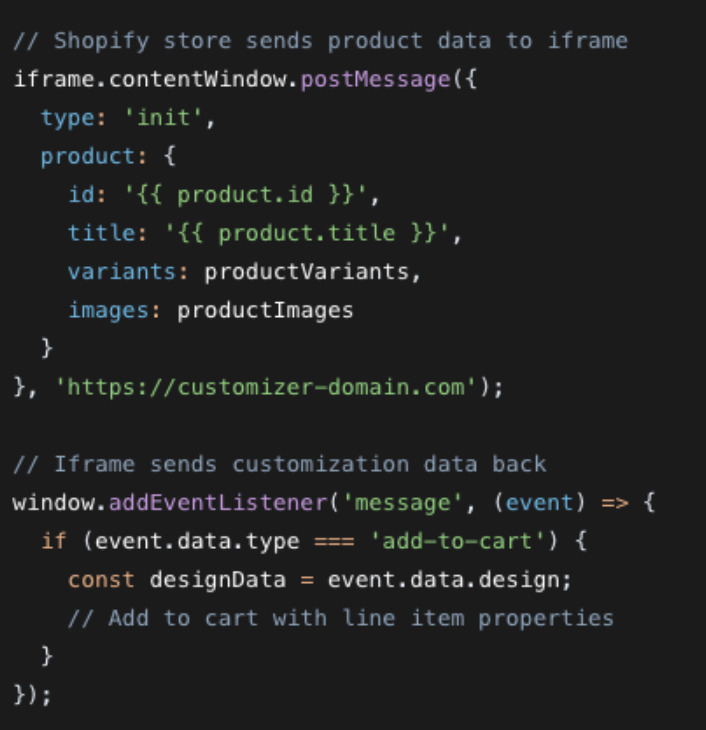
The most common integration method embeds the Three.js application in an iframe, using the PostMessage API for two-way communication with the Shopify store:

Complete Integration Workflow

This approach was successfully implemented by Only Solutions LLC for Frost CNC Tooling,

handling tens of thousands of visually distinct product combinations.

Approach 2: Native Shopify Integration with App Blocks

For deeper integration, developers can create Shopify app blocks that render Three.js directly on product pages:

  • Upload 3D models to Shopify's file system or CDN
  • Create a custom app block using Shopify's theme extension architecture
  • Render Three.js canvas within the product page
  • Update Shopify variants and pricing based on user selections

Studio-Canuk, a Canadian furniture manufacturer, implemented this approach using React Three Fiber, allowing customers to customize wood types, colors, and finishes with real-time price updates.

Approach 3: ModelViewer for Simplified 3D Display

For stores needing basic 3D viewing without complex customization, Shopify's ModelViewer

component provides a lightweight solution. Built on Three.js and WebXR, it enables:

  • 360-degree product rotation
  • Zoom and pan functionality
  • AR placement on mobile devices
  • GLTF/GLB format support

Want a 3D Configurator for your Shopify Store

Let's discuss how FiberDepth can transform your customer experience with interactive 3D and AR.

Book a Technical Demo

30-minute meeting • No commitment • Free consultation
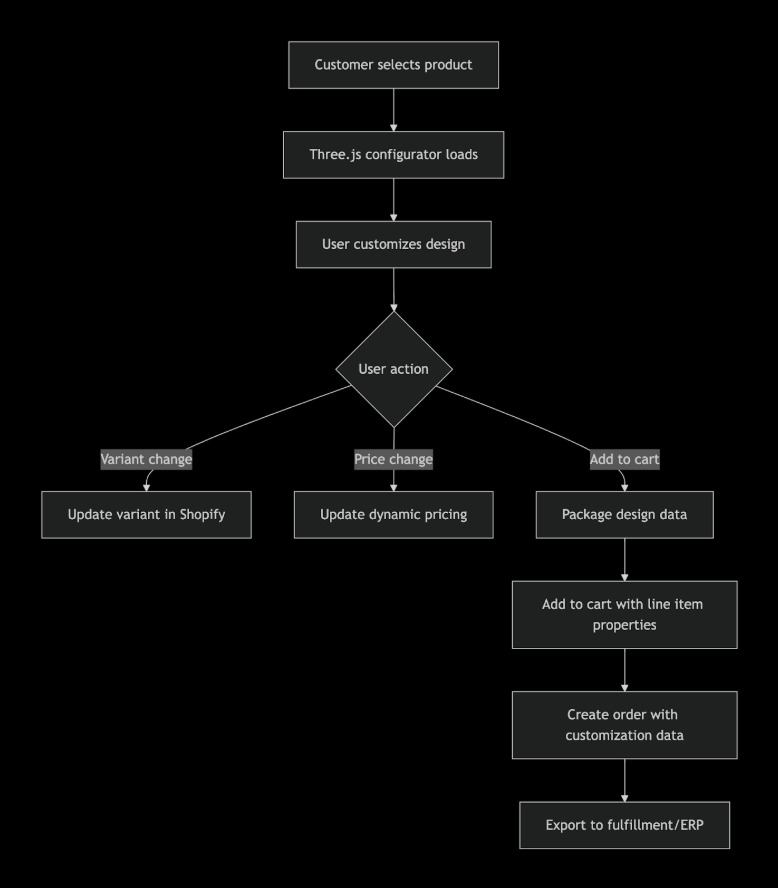
Data Flow and Shopify Integration Architecture

Complete Intergration Workflow

Complete Integration Workflow

Data Persistence Strategies

MethodUse CaseImplementation
Line Item PropertiesStore customization data with orderproperties: {_design: JSON.stringify(design)
MetaFieldsStore configuration dataProduct metafields for default settings
Custom Product CreationUnique configurationsCreate newe product/variant on-demand via Admin API
External DatabaseComplex design dataStore in external system, reference in order

Fost CNC Tooling implemented an innovative approach where new products are created

on-demand via the Shopify Admin API when customers complete customizations, translating

selections into specifications, generating product images, and calcultaing dynamic pricing

Performace Optimization Techniques

Model Optimization

  • Use compressed GLTF/GLB formats instead of OBJ or STL
  • Implement level-of-detail (LOD) rendering for complex models
  • Leverage CDN delivery for 3D assets
  • Apply texture compression and mipmapping

Rendering Performance

  • Limit draw calls by merging geometries where possible
  • Use instanced rendering for repeated elements
  • Implement progressive loading for complex scenes
  • Consider 2D physics for complex simulations (as demonstrated by Shopify's 400% performance improvement)

Mobile Optimization

  • Responsive canvas sizing based on viewport
  • Touch interaction optimization for mobile gestures
  • Bandwidth-aware loading for cellular connections
  • Progressive enhancement with fallback 2D options

Business Impact and ROI

Measurable Outcomes

MetricImprovement
Conversion Rate +41% for home decor with 3D+AR
Average Order Value+32% for apparel with customization
Return Rate Reduction-28% for gifts with previews
Order Processing TimeFaster for B2B with CSV uploads

Case Example: Marevo Furniture Configurator

The Ukrainian company Marevo implemented a complete Three.js configurator with:

  • Responsive canvas sizing based on viewport
  • Touch interaction optimization for mobile gestures
  • Bandwidth-aware loading for cellular connections
  • Progressive enhancement with fallback 2D options

Challenges and Solutions

Common Implementation Challenges

ChallengeSolution
Browser compatibility Feature detection, fallback 2D options
Load time impactProgressive loading, CDN, model optimization
Complex state managementCentralized state with React/Vue
SEO considerationsServer-side rendering for critical content

Security Considerations

  • Origin validation for iframe communication
  • Sanitize user-uploaded content (images, text)
  • Rate limiting for API calls/span
  • GDPR/CCPA compliance for stored design data

Want to bridge the "Imagination Gap"?Learn how we integrate Web-Native AR into Shopify →

Want a 3D Configurator for your Shopify Store

Let's discuss how FiberDepth can transform your customer experience with interactive 3D and AR.

Book a Technical Demo

30-minute meeting • No commitment • Free consultation

Tags :